WINMEDIC Viewpoint: Digital Pathology AI — Industry Status, Implementation Bottlenecks and Pragmatic Development Path
Based on special global research on digital pathology AI and consensus from multi‑party discussions among industry‑university‑medical‑regulatory stakeholders, WINMEDIC analyzes the industrial status, core barriers and evolution rules from a practical implementation perspective. The core value of pathology AI lies not in maximizing algorithm parameters, but in delivering standardized and scalable clinical practical value. The industry focus has shifted from technical exploration to ecosystem building and clinical implementation.
I. Industry Status: Rapid Technological Iteration Lagging behind Industrial Implementation
The global pathology industry is confronted with the dual plights of talent shortage and insufficient digital transformation, showing a feature of “hot technology yet cold implementation”. According to The Insight Partners, the global pathology market reached approximately USD 411.2 billion in 2025 and is projected to hit USD 731.4 billion by 2034 [1]. Diagnostic laboratories worldwide continue to grapple with staffing and reimbursement pressures: 38 % of laboratory managers cite staff shortage as their top challenge, while 31 % rank declining reimbursement levels as their primary concern [2]. The industry is in urgent need of digital tools to cut costs and boost efficiency.
Nevertheless, there exists a notable gap between market perception and real‑world deployment: only 59 % of laboratory managers believe digital pathology and AI exert high or extremely high influence on precision medicine [2]. KLAS estimates that fewer than 10 % of U.S. medical institutions adopted digital pathology for clinical applications in 2023, and less than 5 % of diagnostic cases were reported via digital workflows [3]. As of 2026, fewer than 15 % of U.S. medical institutions have selected digital pathology vendors and entered the deployment or adoption phase. Even among early adopters, full‑scale digitalization remains uncommon; large institutions typically complete digital slide review for less than half of their histopathology cases [4].
In China, pathology‑oriented foundation models and vision‑language models are evolving rapidly. The pre‑training‑and‑fine‑tuning paradigm reduces annotation dependency and supports cross‑disease and cross‑center migration, equipping AI to evolve toward comprehensive clinical decision support. The real industry bottleneck is not algorithm accuracy, but the lack of underlying standards, imperfect system ecosystems and inadequate clinical adaptation. Fragmented platforms, inconsistent data standards and poor workflow adaptation prevent advanced algorithms from translating into tangible clinical value.

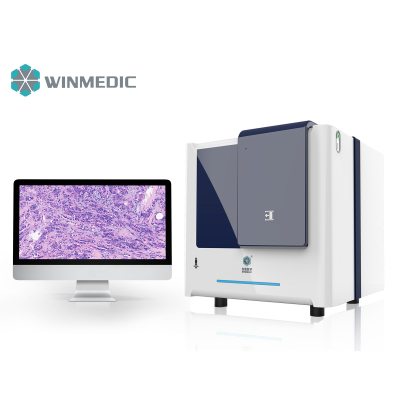
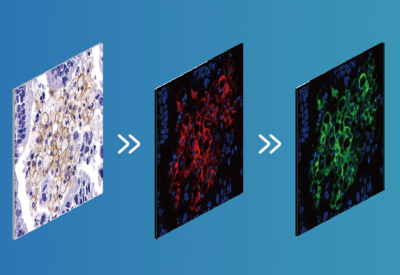
Quantitative Analysis | WINQUANT © WINMEDIC
II. Five Core Barriers to Implementation
The deployment of pathology AI represents a comprehensive challenge spanning standards, workflows, data, compliance and ecosystems:
Insufficient algorithm explainability: The “black‑box” nature of AI leads to opaque decision‑making logic. Lacking interpretability, AI struggles to meet the high rigor and accountability requirements of pathological diagnosis, resulting in low clinician trust. Most models are trained on retrospective datasets, lacking sufficient validation on large real‑world clinical samples and empirical evidence for long‑term stability.
Difficult system integration and workflow transformation: Poor compatibility exists between hospital‑existing LIS, IMS systems and AI solutions. Integrating AI into existing workflows incurs high costs and long lead times. System integration capability weighs more heavily on project success than algorithm performance metrics.
Constraints from data and annotation systems: High‑quality pathological annotations rely on senior experts, bringing high costs and a lack of unified annotation standards. Divergences across hospitals in sample processing, staining, scanning devices and data formats hinder cross‑center data integration. Coupled with ambiguous privacy and intellectual‑property rights, such issues impair model generalization performance.
Stringent compliance and regulatory constraints: Pathological data counts as highly sensitive privacy data amid tightening regulations. The NMPA has not yet opened access for histopathology foundation‑model approvals in China. Many commercially available applications are pseudo‑AI big‑data models, creating compliance hurdles for unlocking data value and iterative model improvement.
Uneven infrastructure resource allocation: End‑to‑end digital pathology construction entails substantial costs for equipment, computing power and workflow retrofitting, which grassroots facilities cannot afford, further widening regional disparities in diagnostic capabilities.
III. Three‑Stage Technical Evolution Path
Pathology AI should advance step‑by‑step; leap‑frog implementation tends to result in clinical failures.
Digital‑foundation stage: Complete slide scanning and digital‑image‑based slide review. Deployed for teleconsultation, education and multi‑disciplinary meetings to resolve resource‑sharing and geographic‑access barriers — a prerequisite for intelligence.
AI‑assisted diagnosis stage (current mainstream): Establish a workflow of “scanning → slide review → AI analysis → clinician interpretation”. AI undertakes repetitive tasks such as scoring and quantitative analysis to assist with approximately 20 % of primary diagnoses. Its role is to empower rather than replace clinicians.
AI precision‑empowerment stage: AI mines micro‑information imperceptible to the human eye. It integrates whole‑slide images, spatial omics, clinical follow‑up and other multi‑modal data to enable prognosis assessment, therapeutic‑effect prediction and risk stratification, supporting precision medicine.

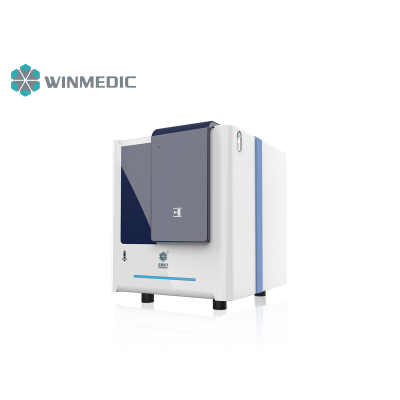
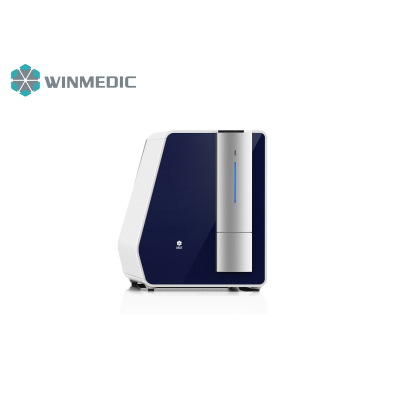
Teleconsultation | WinTele © WINMEDIC
IV. Four Pragmatic WINMEDIC Development Principles
Break free from common industry misconceptions: “over‑emphasizing algorithms over implementation, chasing gimmicks over tangible outcomes”.
Prioritize underlying standards: Adopt CSP/DICOM/SVS+WSI as mandatory foundational specifications. Prioritize building standardized, highly‑compatible underlying infrastructures. AI‑readiness for laboratories focuses on workflow governance instead of merely procuring cutting‑edge technologies.
Operational AI first, diagnostic AI second: Roll out low‑implementation‑barrier operational‑AI applications first, covering image quality control, automated scanning and data‑stream processing. These address pain points including low scanning efficiency, artifact oversight and human error to lower hospital digital‑transformation costs, before iterating toward diagnostic‑assist capabilities.
Uphold human‑AI collaboration: Position AI as an auxiliary efficiency‑enhancing tool instead of a clinician replacement. Focus on four scenarios: collaborative consultation, end‑to‑end quality control, reproducible quantitative scoring and prognostic testing. Clinicians retain final decision‑making authority, aligning with clinical accountability frameworks.
Lightweight models to lower implementation barriers: Leverage foundation‑model self‑supervised learning to reduce annotation dependency and improve cross‑center adaptability. Adopt SaaS/AIaaS models supporting flexible cloud‑based or on‑premises deployment, enabling on‑demand model invocation and continuous iteration to ease investment burdens for grassroots medical institutions.

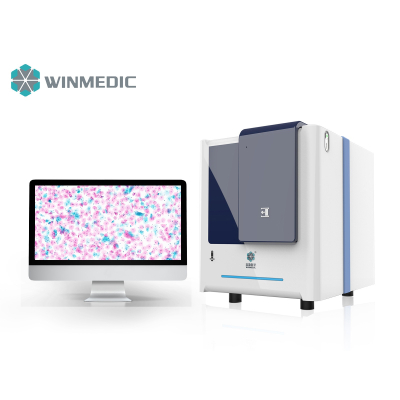
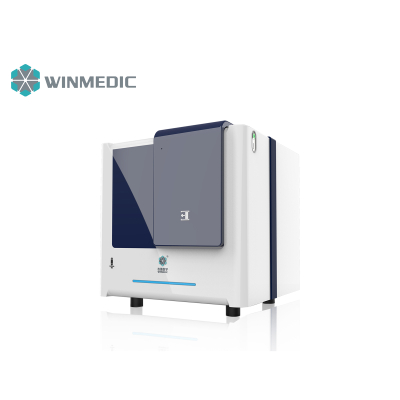
Cytology Image Processing | WinCyto © WINMEDIC
V. Future Industry Trends and Strategic Focus
Industry competition is shifting from single‑algorithm performance benchmarking toward comprehensive evaluation of standardization, ecosystem adaptability, real‑world clinical value and sustainable iteration capacity. Three major shifts are underway:
Technology side: Static image classification → dynamic disease modeling and multi‑modal intelligent prediction
Implementation side: Isolated point‑of‑use tools → end‑to‑end standardized ecosystem deployment
Value side: Optimizing algorithm metrics → enhancing real‑world clinical value and equitable medical‑care accessibility
WINMEDIC will remain committed to a pragmatic implementation‑oriented approach. Rooted in standardized underlying infrastructures, guided by unmet clinical needs, centered on human‑AI collaboration and enabled by lightweight service models, WINMEDIC will continue refining its full‑cycle AI‑readiness system covering “foundation construction ‑ planning & deployment ‑ training & empowerment ‑ iteration & optimization”. On one hand, it will deepen operational‑AI scenarios to resolve fundamental industry pain points. On the other hand, it will continuously advance foundation‑model‑driven intelligent diagnostic capabilities, improve data‑compliance and governance systems, and drive pathology AI from proof‑of‑concept and sample‑level testing toward regular, large‑scale clinical adoption. This will help build an efficient, equitable and sustainable precision‑pathology care ecosystem.
References
[1] THE INSIGHT PARTNERS. Global Pathology Market Trends, Share and Demand to 2034[EB/OL]. 2026‑04‑17[2026‑09‑02].
[2] PROSCIA. 2025 Laboratory Leadership Report: Insights into Digital Pathology, Artificial Intelligence and Precision Medicine[R/OL]. 2025.
[3] TATE S, LAGEMANN E. US Digital Pathology 2023: Deep Dive into Successes and Lessons Learned from Early Clinical Adoption Sites[R/OL]. KLAS Research, 2023‑11‑10.
[4] LAGEMANN E, CHRISTENSEN J, CORBETT S. US Digital Pathology 2026: Early Adoption and Technology Performance in the Emerging U.S. Market[R/OL]. KLAS Research, 2026‑02.